
What to see in Bucharest: must-see attractions and handy travel tips

Bucharest, the dynamic capital of Romania, is a city that effortlessly blends its rich and often complex history with a vibrant modern energy. From grand Belle Époque architecture that earned it the nickname “Little Paris” to imposing communist-era structures and a thriving contemporary culture, the city offers a captivating tapestry for every traveler. This guide will take you through some of the must-see sights that make Bucharest a truly unique and unforgettable destination.
Where is Bucharest
Bucharest is the vibrant capital and largest city of Romania, a country in southeastern Europe. To be more precise, you’ll find Bucharest situated in the southeastern part of Romania, in the historical region of Wallachia. It lies on the banks of the Dâmbovița River, on the Romanian Plain.
Geographically speaking, Bucharest holds a fascinating position as a gateway. To the north, the majestic Carpathian Mountains beckon, while to the east lies the alluring Black Sea coast. This strategic placement has played a significant role in shaping its history and continues to contribute to its captivating mix of influences and architectural styles.

Bucharest: quick history bites
Bucharest may seem like a modern capital, but its roots go way back—we’re talking Paleolithic times. Archaeological finds show that this area was the oldest continuously inhabited site in Romania. Still, what we’d call an actual urban center didn’t emerge until the late 14th century.
The region was home to the Dacians for centuries, but real development began after Mircea the Elder, Prince of Wallachia, defeated the Ottomans in 1395. That victory led to the construction of a fortress, likely managed by a military governor named Bucur—yes, the name “Bucharest” probably comes from him. Surprisingly, Mircea isn’t officially considered the city’s founder. That honor goes to Vlad III of Wallachia—also known as Vlad the Impaler, the inspiration for Dracula—who signed the first written mention of Bucharest in a Latin document dated September 20, 1459.
Thanks to its strategic location, Bucharest became a frequent battleground. For centuries, power shifted between the princes of Wallachia and Moravia on one side and the Ottoman Empire on the other. The city was conquered, burned, and rebuilt multiple times—most notably in 1595, when Ottoman forces, expelled by Romanian troops led by Michael the Brave with Austrian support, destroyed Bucharest before retreating. Despite the turmoil, the city grew into the most important commercial, political, and economic hub in Wallachia and Moravia by the 16th century.
In the 19th century, Romania became a tug-of-war zone for the Ottoman, Austrian, and Russian empires. Bucharest suffered damage during repeated conflicts, with many historic buildings and monuments lost, but a turning point came in 1859, when the various Romanian territories unified and Bucharest was declared capital of the new Kingdom of Romania. The city thrived, earning it the nickname “Little Paris” thanks to its elegant boulevards and Belle Époque architecture.
Then came the 20th century, and things got rough again. During World War I, the city was occupied by German troops. In World War II, it was heavily bombed by Allied forces and struck by a massive earthquake in 1940. Not long after the war, on December 30, 1947, Soviet troops helped overthrow the monarchy and install a communist dictatorship. A second major earthquake hit in 1977, during the reign of dictator Nicolae Ceaușescu. Much of the city was rebuilt in Soviet architectural style, including the massive Parliament building that still dominates the skyline today.
TO DO: enrich your stay and create unforgettable moments on this authentic tour of Bucharest*. Discover the city’s history, art, and secrets as you explore with a local artist guide.

What to see in Bucharest
From grand architectural statements that echo its “Little Paris” past to poignant reminders of more recent history and vibrant cultural hubs, here’s what to see in Bucharest during your stay.
Lipscani
Lipscani represents the beating heart of Bucharest’s historic center—a vibrant maze of cobblestone streets and storied facades where the past and present blend effortlessly. For centuries, this area stood as the commercial nucleus of Wallachia and the very name “Lipscani” reflects its mercantile legacy, derived from the German city of Leipzig—“Lipsca” in old Romanian—a nod to the traders who once brought their wares here from Western Europe. Even today, the streets echo with the memory of those professions: Stradă Blănari, Stradă Șelari, Stradă Șepcari, and Stradă Zarafi—each named after the artisans and merchants who once defined the district’s economic rhythm.
At the northern edge of Lipscani lies Piața Universității (University Square), a landmark deeply woven into the intellectual and political fabric of Romania. Framed by statues honoring national figures like Ion Heliade Rădulescu, Gheorghe Lazăr, Spiru Haret, and Michael the Brave, the square is a natural starting point for exploring the area. The nearby Suțu Palace, a refined neo-Gothic residence from 1835, now houses the Bucharest Municipal Museum, where crystal chandeliers and historic artifacts tell the city’s story.
Venturing further, the majestic Biserica Sfântul Gheorghe Nou reveals the artistic richness of the Brâncoveanu style, blending Orthodox and Islamic elements into a unique architectural harmony. Built in the early 18th century, the church holds the relic of Saint Nicholas’s right hand and the tomb of Constantin Brâncoveanu, martyred for refusing to renounce his Christian faith. Its vividly colored frescoes and delicately carved stone columns make it one of Bucharest’s most beautiful places of worship.


To the west, Lipscani brushes against Calea Victoriei, an elegant boulevard lined with aristocratic buildings, luxury hotels, and cultural institutions. Along this thoroughfare, you’ll find the National History Museum, housed in a grand neoclassical former post office, as well as the CEC Palace, a masterpiece of Beaux-Arts architecture topped with a dramatic glass dome. The nearby Macca-Vilacrosse Passage, built in 1891, offers a Belle Époque atmosphere with its yellow-tinted glass ceiling and Middle Eastern-inspired cafes.
At the spiritual heart of Lipscani is the Stavropoleos Church, the sole surviving element of a former monastery and a quintessential example of Brâncoveanu design. Built in 1724 by a monk from Epirus, it stands as a testament to the endurance of religious art and devotion. Its serene courtyard, filled with medieval tombstones and relics, offers a quiet escape amid the bustle of the city center.


For those intrigued by Bucharest’s more recent past, the Muzeul Micul Paris offers an intimate look at the city’s golden age, when it earned the nickname “Little Paris.” Housed in a historic building, its collection of period garments, photographs, and everyday objects brings the elegance of 19th and early 20th-century life into vivid focus.
Just a short stroll away stands Cărturești Carusel, a bookstore unlike any other. Once the headquarters of the Chrissoveloni banking family and later a communist-era department store, the building now shines as one of the most beautiful bookstores in the world. With its white columns, skylit atrium, and six levels of books, vinyl, games, and curated gifts, it’s a haven for readers and curious wanderers alike.
TO DO: discover Bucharest’s Old Town in a fun small-group tour for 12 max! History, legends, hidden spots, and street charm — all wrapped into one unforgettable walk*.


Piața Revoluției (and its surroundings)
Piața Revoluției, or Revolution Square, named in commemoration of the Romanian Revolution of 1989, holds a significant place in Romania’s history. It was the stage for two pivotal mass events that marked both the zenith and the decline of Ceaușescu’s regime.
The first of these occurred on August 21, 1968. On this day, Ceaușescu reached the peak of his popularity with a powerful speech openly condemning the Soviet invasion of Czechoslovakia, signaling the beginning of a policy of independence from Moscow. The second, a stark contrast, took place on December 21, 1989. In an attempt to replicate the success of the 1968 rally, Ceaușescu delivered a speech that instead ignited the popular revolt, ultimately leading to the downfall of his authoritarian rule.
Today, the square is framed by numerous buildings of historical, artistic, political, and cultural importance. These include the Royal Palace (Palatul Regal), now home to the National Museum of Art of Romania; the Romanian Athenaeum (Ateneul Român), the city’s premier concert hall and a symbol of Romanian culture; the Palace of the University Foundation Carol I (Palatul Fundației Universitare Carol I), housing the Central University Library; the Palace of the Ministry of Internal Affairs; and the charming Crețulescu Church. Adding to the square’s significance are its monuments, such as the equestrian statue of Carol I and the poignant Memorial of Rebirth.


The Palace of the Parliament in Bucharest
The Palace of the Parliament (Palatul Parlamentului) serves as the seat of the Romanian Parliament and the Constitutional Court. It holds the distinction of being the heaviest building in the world and the second-largest administrative building globally by surface area (over 350,000 square meters), and the third by volume.
Designed by architect Anca Petrescu, the palace is a testament to Romanian craftsmanship, constructed using materials sourced from every corner of Romania – from Transylvanian marble to walnut, oak, cherry, and elm woods from forests across the country.
During the communist era, it was known as the People’s House (Casa Poporului). Its construction took five years, with the intention of housing all major state institutions, including the Presidency, the Grand National Assembly, the Council of Ministers, and the Supreme Court. It only became the seat of the Parliament in 2004, which was previously located in the Central Committee building of the Communist Party.
TO DO: go on a guided tour of the Palace of Parliament*, a must-see when visiting Bucharest. Stroll through enormous hallways and rooms, see busts of Romanian kings, and visit Europe’s biggest ballroom.

The Patriarchal Cathedral
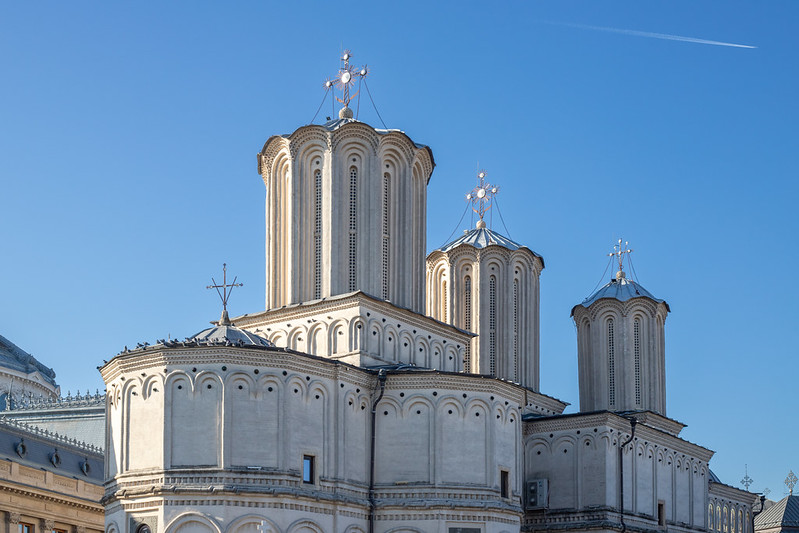
The Cathedral of Saints Constantine and Helena (Catedrala Sfinții Împărați), often simply known as the Patriarchal Cathedral (Catedrala Patriarhală), is a significant Orthodox place of worship that also serves as the seat and official residence of the Patriarch of Romania.
Consecrated in 1658, this important architectural complex has undergone several renovations throughout the centuries, with the most recent interventions dating back to the 1960s. Today, the Patriarchal Cathedral is rightly considered one of the most important and revered historical monuments in all of Romania.
The Arch of Triumph
The Arch of Triumph (Arcul de Triumf) in Bucharest stands as one of the capital’s most prominent monuments. It was erected between 1935 and 1936 to commemorate Romania’s victorious participation in World War I.
Interestingly, the current structure is actually the third triumphal arch to have been built in the city. The first, made of wood in honor of Romania’s Independence gained in 1878, was a temporary solution to properly welcome the troops returning from the recent conflict. The second arch, constructed from wood and stucco, was erected shortly after World War I, before being replaced by the majestic granite structure we admire today.
Standing tall at 26 meters, Bucharest’s Arch of Triumph pays homage to the famous Parisian Arc de Triomphe. Every year, on December 1st, it serves as a grand stage for Romania’s National Day, hosting military parades and vibrant performances. Inside, a staircase invites visitors to climb to the top and enjoy a breathtaking panoramic view of the capital.
TO DO: discover the Arch of Triumph in Bucharest with this entry ticket*. Explore a photo-documentary exhibition, see effigies of King Ferdinand I and Queen Marie, and enjoy a panoramic view.

The “Dimitrie Gusti” National Village Museum
The “Dimitrie Gusti” National Village Museum is a fascinating open-air museum, founded by the renowned folklorist and sociologist Dimitrie Gusti. Inaugurated in 1936, the museum was established with the ambitious goal of illustrating the vernacular architecture, evolution, and rich heterogeneity of Romanian society on a national scale. Through its exhibits, the museum highlights the unique characteristics of different villages found in the various regions of the country.
Carefully laid out within the picturesque “Regele Mihai I” Park, the museum features authentic houses and buildings that were meticulously dismantled and transported to Bucharest using no fewer than 56 railway cars. Here, they were skillfully reconstructed by 130 artisans, an operation that did not go without some debate at the time. Today, inside these traditional structures, visitors can admire period furniture, traditional furnishings, everyday objects, and clothing that vividly depict Romanian traditional life in all its facets.
Expanded in 2016, the museum now covers an area of 3.5 hectares and requires approximately a whole morning to fully explore.
TO DO: discover the city of Bucharest with a guided visit at Village Museum*. Get picked up from your hotel in the center of Bucharest and head to the Village Museum, an open-air ethnographic museum.

Bucharest’s Parks: “Regele Mihai I” Park and Cișmigiu Gardens
Bucharest unveils itself as a city rich in green spaces, true havens perfect for indulging in moments of relaxation and a pleasant immersion in nature. Among the parks I had the pleasure of visiting, I particularly recommend “Regele Mihai I” Park and the charming Cișmigiu Gardens.
Known until 2017 as Herăstrău Park, “Regele Mihai I” Park majestically stretches over 180 hectares, embracing the shores of the picturesque Lake Herăstrău. This vast green oasis offers fascinating views, framing some of the city’s imposing skyscrapers in the distance. Cișmigiu Gardens, while smaller in size, is no less captivating. Dating back to 1847, it is said to be the oldest park in the capital, strategically located a short distance from Lipscani and the iconic Royal Palace.
TO DO: discover the green side of Bucharest by bicycle, using bike lanes and park lanes. Whit this guided tour* you can see the main attractions of the city.

Radu Vodă Monastery
The Radu Vodă Monastery (Mănăstirea Radu Vodă) holds a position of primary importance among the places of worship in the Romanian capital. It stands in an area that, according to valuable archaeological findings, represented the first inhabited nucleus from which the entire city of Bucharest originated.
Founded in the distant 16th century, the monastery had the honor of housing Bucharest’s first library. In the turbulent year of 1595, during the Ottoman invasion, it was temporarily transformed into a mosque. However, with the retreat of the troops, the building suffered partial damage and was subsequently fully rebuilt as an Orthodox monastery in 1625.
Severely damaged by the violent earthquakes that shook the capital during the 19th century, the Radu Vodă Monastery underwent significant restoration work between 1969 and 1974, and was then reconsecrated in 1979. Inside, you’ll find the tomb of Patriarch Justinian Marina, a prominent figure in the Romanian Orthodox Church during the 20th century.

Ceaușescu’s House
Ceaușescu’s House, also known as Palace of the Spring (Palatul Primăverii), is a lavish residence that served as the private home of the dictator Nicolae Ceaușescu and his family until the fall of the regime in December 1989.
This palace, built in the 1960s, remained inaccessible to the public for decades. It only opened its doors to visitors in 2016, quickly becoming one of Bucharest’s most fascinating attractions. Inside, over 80 rooms unfold, including opulent reception halls, private offices, luxurious bedrooms, bathrooms lavishly decorated with precious marbles, handcrafted furniture, and a surprising indoor swimming pool, entirely adorned with Byzantine-inspired mosaics. Completing this picture of opulence are valuable works of art and collections of ceramics and Persian carpets that testify to the Ceaușescu family’s eccentric taste.
You are not allowed to take pictures inside.
TO DO: join this private tour* to learn about the history of communism in Romania and see some of the most important sites linked to this history, including Ceaușescu’s Mansion.
Therme București
Located just a few kilometers from Henri Coandă International Airport, Therme București is the largest thermal wellness center in Europe—and one of the biggest in the world. Whether you’re starting or ending your Romanian adventure, this is the perfect place to unwind, recharge, and enjoy a full day of relaxation, wellness, and fun.
Opened in 2016 in the town of Balotești, the spa spans over 30,000 square meters and uses natural thermal water drawn from a depth of more than 3,100 meters. This water is microbiologically pure and rich in minerals such as copper, zinc, selenium, calcium, and magnesium. It’s kept at a soothing temperature of 33°C (91°F) all year round, and the entire indoor environment is maintained at around 30°C (86°F).
The complex is divided into three main zones, each with its own atmosphere and entry fee: Elysium, The Palm and Galaxy. Moreover, there are eight dining areas across the facility, each accessible only if your ticket includes that specific zone.
TO DO: reserve your ticket to the Therme București* wellness spa, located just outside of Bucharest. Benefit from convenient round-trip transportation from several pickup points within the city.

Tips & tricks to visit Bucharest
From getting around the city to where to eat or sleep, there are a few things to keep in mind to ensure a smooth and enjoyable experience. Here are some practical tips to help you navigate Bucharest like a pro!
How to get to Bucharest
Reaching Bucharest is quite straightforward, as the city boasts excellent transport links. The primary gateway for international travelers is Henri Coandă International Airport (OTP), located about 18 kilometers (11 miles) north of the city center. Numerous airlines offer direct flights from major European and international cities.
For those traveling overland, Bucharest is well-connected by train to other major Romanian cities and neighboring countries. The Gara de Nord is a large and busy station with good connections to the city’s public transport network. Long-distance buses also arrive at various stations around the city.
TO DO: book a private airport transfer* to or from the airport with a professional driver.
How to move around
Exploring Bucharest is made easy by its diverse transport options. The efficient and clean metro system offers the quickest way to connect to many key areas and popular tourist spots via its four main lines, while a comprehensive network of buses and trams also crisscrosses the city, reaching areas beyond the metro lines, with single tickets and day passes as options, though travel times can be influenced by traffic.
Taxis are widely accessible, either hailed on the street or booked through ride-hailing apps, where ensuring the meter is running or agreeing on a fare beforehand is advisable. Services like Uber and Bolt provide a convenient alternative for city navigation.
Furthermore, Bucharest’s central districts, particularly the Old Town and surrounding boulevards, are very pedestrian-friendly, inviting you to explore their charm and hidden corners on foot.
TO DO: discover, interact, and learn during this multi-stop walking tour* around the city of Bucharest. Follow alongside a guide to see the old court citadel, Cismigiu Gardens, Ceausescu Palace, and more.
Where to stay in Bucharest
During my time in Bucharest, I stayed in a charming little apartment right in the heart of the Old Town (Lipscani), the Cozy Old Town Apartment 9*. While the accommodation was quite compact, it proved perfect for two (or even three) people who plan to spend most of their time exploring the city. Equipped with a small kitchen, it’s also ideal if you’d like the option of preparing and enjoying some meals at home.

*Links marked with an asterisk are affiliate links. This means that if you choose to book or buy something using these links, I will earn a small commission. There is absolutely no extra cost to you, but your purchase helps support this blog and the effort that goes into creating each post. Thank you for your support!
